
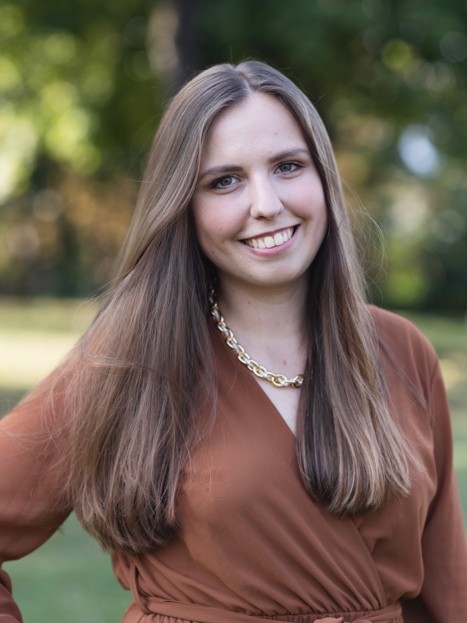
My name is Michaela Sotáková and I graduated from GYMES in 2021. I am grateful that throughout all five years my class teacher was Zuzana Trail. My closest friends from my year were, and still are, Terezka Füleová, Františka Sorgerová (now Sviatková), Ema Gromová (now Dečová) and Aďo Pastorek. At the same time, I must honestly say that many other GYMES students are still close to me today, and I always enjoy it when my path crosses with someone from my secondary school years. Recently, for example, I was very happy to meet Anna Gburíková by chance when we happened to fly to the Netherlands together, where we are both currently studying. I was also grateful for the time spent with Nina Danišová at the College, with Danka Fabišíková and with Rado Hospodár. I always enjoy meeting all of them, even though we are not from the same year group.
After GYMES I went on to study psychology at the Faculty of Arts of Comenius University in Bratislava. Alongside my studies I completed a course in cardiovascular psychology in Uppsala in Sweden, and I am currently studying at a university in Tilburg in the Netherlands. Two years spent at the Anton Neuwirth College were also very enriching for me, where I often met GYMES graduates who also have a strong presence in that community.
Thanks in part to the experience of writing a year project at GYMES, I was able to become involved in a student research conference at university immediately. My team succeeded in the international round and we managed to publish our first scientific article already in the first year of university. Alongside my studies I completed an internship at the social cohesion research institute Dekk and had the opportunity to observe the work of the Memory research centre, which focuses on neuropsychology. In addition to my psychological interests, I was also greatly involved in event management in projects such as the Women’s Catholic Conference, the Free Society Seminar, the Conservative Summit, and the Anton Neuwirth College itself, where I later remained as an intern.
I try to remind myself of the Benedictine motto Ora et Labora, to seek the Truth and to work towards fulfilling the meaning of my life.
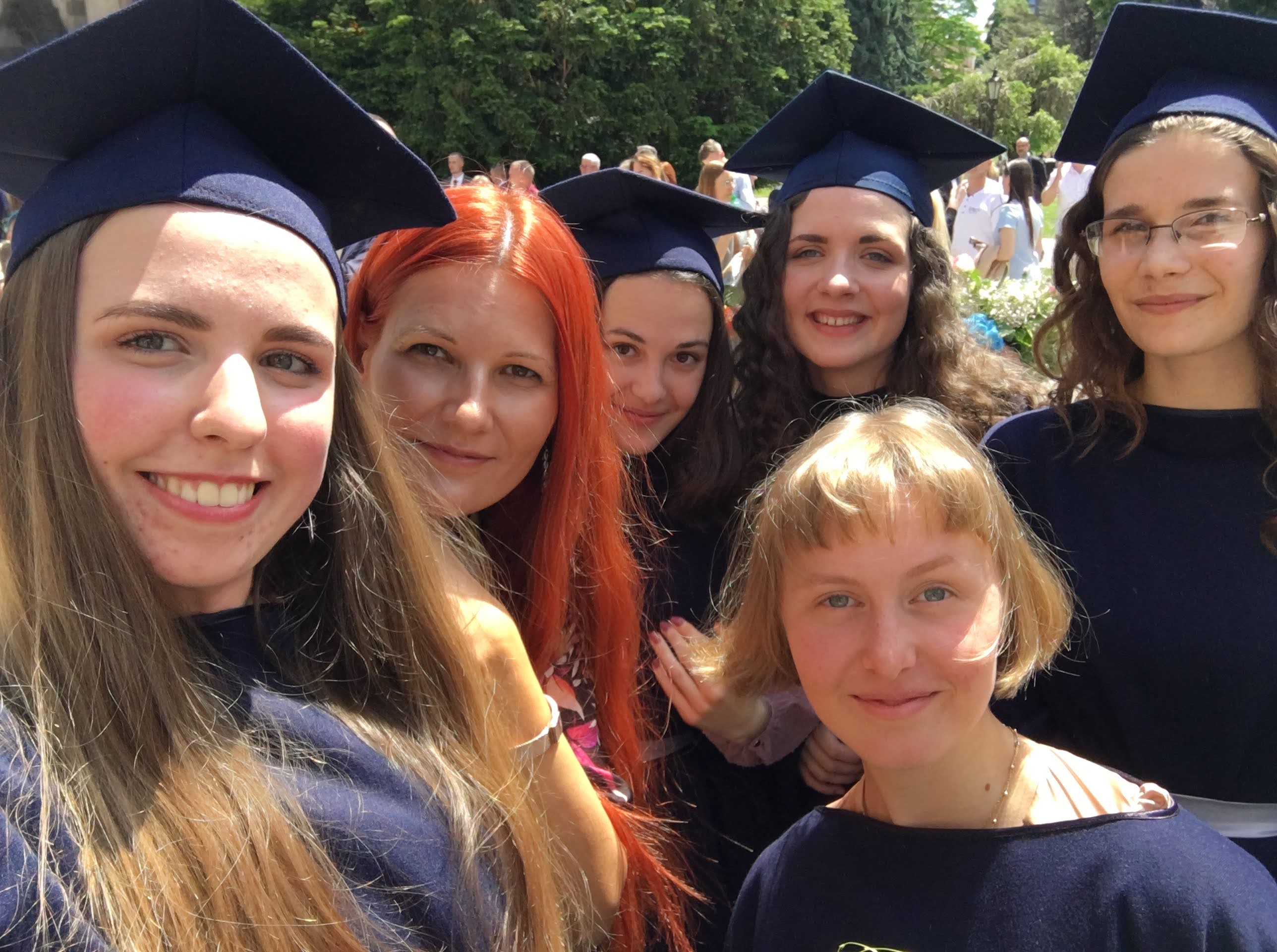
If you had to decide again, would you choose GYMES once more?
Yes. I still remember vividly how close I was to choosing another grammar school because I thought that going to a five-year grammar school after the ninth year and thus extending my studies by a year was not a sensible idea. However, I decided to attend the enrolment meeting, where each accepted student personally met the then headmistress Mária Dečová. That conversation and personal meeting with her changed something in me, and in the end I chose GYMES. I am convinced that if I had not gone to GYMES, my life today would look completely different. I would probably be studying something else and might not have found the courage for many things. Throughout those five years GYMES encouraged self-discovery, curiosity, the exploration of talents and opportunities for self-realisation. It cultivated courage, taught perseverance in overcoming obstacles and, above all, offered a supportive and family-like environment. I often think about GYMES and speak about it with pride to the people around me.
How did you perceive the atmosphere at school during your studies?
As I mentioned earlier, at that time GYMES felt very much like a family. Many of us knew one another even across different year groups. This was probably thanks to the many activities available and also to the fact that we moved between classrooms, which increased the chances of meeting one another in the corridors. For example, in the school choir we went on retreats together, shared many experiences, laughed a great deal and became very close. I remember one winter when we went to a mountain lodge and our car became stuck in the snow. Imagine all those girls pushing a stranded car together. The next morning we woke up to a snowy landscape, and our headmistress, who led the choir together with Katka Kapitánová, had slept beside the fireplace to keep the fire burning through the night. I still remember that image today. It felt like a metaphor for what she did for GYMES, and I admired her deeply for it.
Was there anyone among the teachers at GYMES who inspired you or significantly influenced you?
Of course. In fact, I find it difficult to choose just one person. I was fortunate to meet many excellent teachers who, I believe, significantly influenced my life path, perhaps without even realising it. First of all, my class teacher Zuzka Trail, who guided our class with dedication and enthusiasm, became a friend to us, supported us in our journeys and showed us what it means to approach things with passion while teaching English and American literature. Perhaps the person who inspired me most was the former headmistress Mária Dečová. I admired her leadership style, her dedication, wisdom and humanity. She was not afraid to do things differently, and I felt proud that we had such a headmistress. Only now, during my university years, when I speak with peers from other parts of Slovakia, do I fully realise how exceptional our teachers were. They were innovative, passionate, motivating, friendly and wise. That is far from ordinary. I also carry in my heart with great gratitude the influence of Peťo Hric, Tomáš Filip, Ivana Vaľková, Martina Talpašová, Mária Lukáčová, Zuzana Halecká and Katka Kapitánová. All of them inspired me in different ways and left their mark.
Have any of your friendships from GYMES lasted until today?
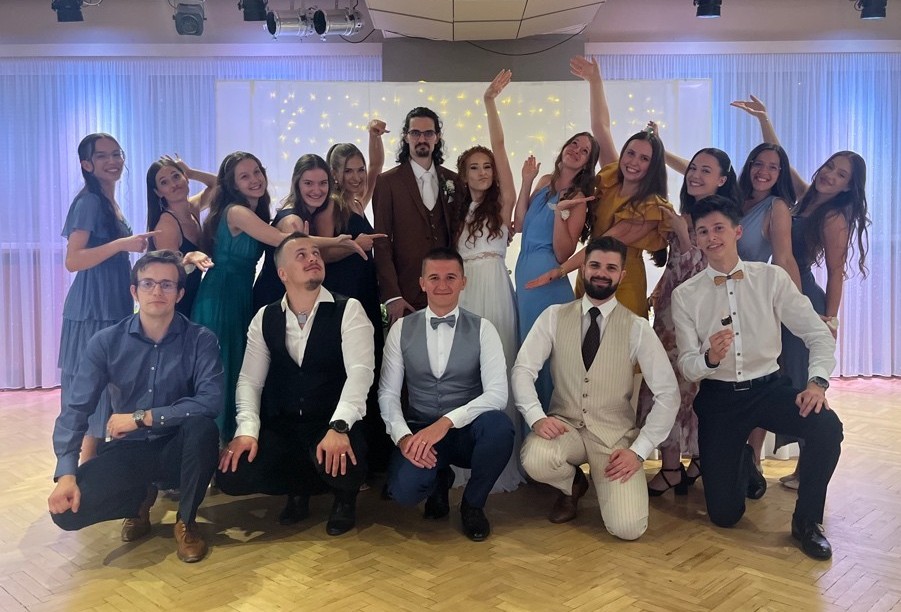
Yes. Together with other GYMES friends we have a tradition of meeting every Christmas. So far we have managed to gather in quite large numbers, and hopefully this tradition will continue. I am fortunate that many GYMES graduates are also part of the community around the Anton Neuwirth College, which makes it easier to remain in contact. Sometimes I even find myself surrounded by so many GYMES alumni that we take a GYMES alumni group photo together. The last time was at the wedding of Ema Gromová and Kuba Deč. But as I mentioned, sometimes our paths simply cross again unexpectedly, and it is always a joy. For example, during lectures by Professor Heretik on forensic psychology last semester I suddenly found myself sitting next to our fellow GYMES student Lenka Gočíková.
Did GYMES help you in any way in your spiritual life?
I think it provided many opportunities and a supportive environment in which my faith could grow and deepen. At that time we also had a very wise chaplain, Peťo Labanc, with whom it was possible to have deep conversations, something I personally appreciated very much. I remember reading 12 Rules for Life by Jordan Peterson with him even before it became widely popular.
What did you feel was missing, or what would you have liked to learn more about?
I would have liked to learn more about Edith Stein already during secondary school. Only later, at the Anton Neuwirth College, did I encounter her book Woman, which is an excellent work about female identity. When I later became involved in the organisational team of the Women’s Catholic Conference, which draws heavily from her ideas, I realised again what an extraordinary patron and philosopher we had at GYMES and how little we actually learned about her. I believe that her story and writings would have much to offer secondary school students, especially girls discovering their own identity.
Which school activity or project was the most unforgettable for you and why?
For me, the Erasmus stay in Gothenburg in Sweden was unforgettable. I was accepted as a substitute participant, so one might say it happened almost by chance. Two years ago I returned to exactly the same place, but in a completely different context, and I even managed to meet Märta, my Swedish exchange partner, again. At that moment I realised that my secondary school trip to Gothenburg had not been a coincidence at all, but an important piece in the puzzle of my life, even though I did not realise it at the time. As I walked through Gothenburg again, I remembered how I had been there years earlier together with my fellow GYMES students.
What advice would you give to current students?
I would encourage them to courageously and honestly search for the meaning of their own lives and not to be afraid to pursue their calling faithfully, even during difficult moments.
To what extent did studying at grammar school help you choose the path you eventually followed?
To a very large extent. If someone had told me at the beginning of my time at GYMES that I would one day study psychology, I would probably have laughed. Yet it was precisely during those years that I discovered how beautiful psychology can be, how it can improve the atmosphere around us, deepen relationships, move people forward and help them flourish. I also have good memories of our school psychologist at the time, Iveta Verebová. It was under her supervision that I wrote my year project on a psychological topic, which later proved very useful at university. I also observed many psychological elements within our school that other schools did not have, but which were already present at GYMES. I saw that they had meaning and that they genuinely transformed the atmosphere of classes and the school. As fifth-year students we also had the opportunity to assist as tutors at a first-year teambuilding event, which confirmed for me how much I enjoy working with people.
Which achievement at GYMES outside the classroom are you most proud of?
I fondly remember helping to build the first media team at GYMES, initially under the guidance of Sister Hermana and later Peťo Hric. It was a beautiful GYMES project that allowed our creativity to flourish and also challenged us to step outside our comfort zones.
What was the greatest challenge you overcame during your studies, and what did it bring into your life?
I cannot name just one challenge, but overall studying at GYMES was often demanding. There were constant preparations for yearly examinations, alongside numerous other activities such as organising the school charity concert, participating in the Duke of Edinburgh’s Award programme, the secondary school Anton Neuwirth College, the school choir, the media team and life beyond school. These challenges taught me to organise my time, work efficiently, moderate my perfectionism and confidently manage pressure and stress. Today I notice that many students from other schools find it difficult to imagine combining university studies with several additional activities. They sometimes panic when they feel overwhelmed and thus miss many valuable opportunities. Together with Nina Danišová at the College we often recalled a remark by Mária Dečová: “The more you have to do, the more you manage to accomplish.” Of course, healthy boundaries are important as well.